
Light Mode

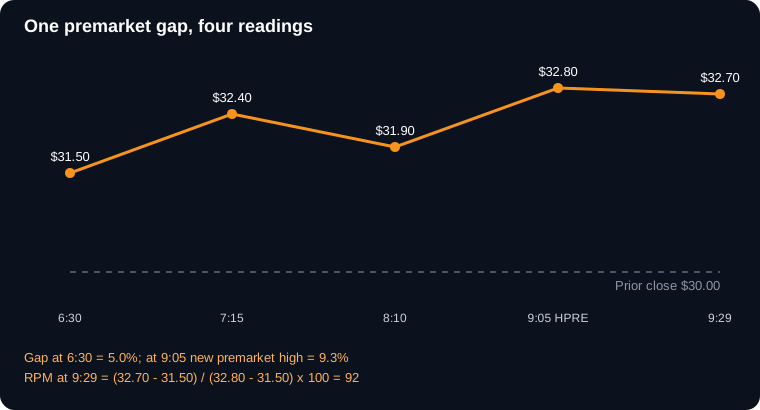
A premarket gap is a moving number. The gap at 7:00 a.m. is rarely the gap at 9:30, so the scan has to keep reading the latest print.
Free account, just an email. No card. 15-minute delayed data.

Named to the Inc. 5000 list of America’s fastest-growing private companies six years in a row (2017–2022).

Investopedia: Best Short Term Stock Screener, 2024
Before the open, Gap (%) and Gap ($) use the latest premarket print against yesterday’s close, so the list re-ranks as trades come in. Three more pieces show whether the gap is growing or shrinking:
Example numbers, not a real trade
Only want gap ups? Set the Gap (%) minimum above zero. Gap downs: set a maximum below zero. For the wider premarket picture, see the premarket scanner.
Premarket isn’t one block of time. It acts different depending on the clock, and a scan that ignores that will show you a lot of noise.
A simple way to fight the thin-print problem is a volume floor that rises with the clock. Some traders run 25,000 shares before 7:00, 100,000 by 8:00 and 250,000 by 9:00. Trade Ideas lets you keep separate saved scans for each, so you just switch windows as the morning goes.
Example, made-up numbers. A $30 biotech prints $33 at 5:10 a.m. on 4,000 shares, a 10% gap. By 7:30 it’s back to $31.20 on 90,000 shares, so the gap shrank to 4%. At 8:40 a second headline hits and it runs to $32.80. The premarket high alert fires there because it topped the earlier 7:00 high. Position in premarket range reads 100. If you had trusted the 5:10 print, you would have been chasing a number that was gone two hours later.
Also watch the distance below the premarket high right before the bell. A stock sitting 3 cents under its high at 9:29 has buyers leaning on it. One sitting 80 cents under has already given some back, and that changes the open quite a bit.
Last thing: premarket highs and lows make handy lines for the regular session. A lot of opening moves start right at them, which is why the alert exists in the first place.
A note on news timing. Many companies report earnings between 6:00 and 8:00 a.m. ET, and the gap can flip in seconds when the numbers cross the wire. If a name on your list goes quiet right before its report, that’s why. Mark the report times on your watchlist so a sudden 12% swing at 7:01 doesn’t surprise you. Then let the volume floor decide whether the new gap is worth your attention or just early noise.
Free account, just an email. No card. 15-minute delayed data.
Premarket gaps, answered plainly.
As soon as a stock prints in the premarket. Early prints are often thin, so many traders wait for real volume before trusting the gap.
No. It is this scan with the Gap (%) minimum set above zero, so we keep it on one page.
The gap is measured against the latest print. If sellers show up at 9:00, the gap gets smaller before the bell.
Early premarket volume is tiny. A rising floor keeps 5 a.m. prints of a few hundred shares from filling your list with gaps that vanish by 8.
Results are not typical. Trading involves risk; most day traders lose money. Past and simulated results don't guarantee future results.
Past results, including backtests, don't guarantee future results.
Free account, just an email. No card. 15-minute delayed data. Ready to buy? See plans & pricing